

 Singapore
 Hongkong
 United States
 Group
Group Log In
This was one of the most remarkable and high-risk spaceflights to date. On Sunday, SpaceX launched its massive Super Heavy Starship rocket on an unmanned test flight, successfully completing a groundbreaking engineering feat by using the giant "Mechazilla" mechanical arms on the launch pad to catch the descending booster stage mid-air.
Meanwhile, the upper stage of the Starship completed a full orbit of the planet and re-entered the atmosphere over the Indian Ocean, enduring temperatures nearing 3,000 degrees as it made a controlled descent to its target.
The spacecraft managed to withstand the intense heat of re-entry in relatively good condition, thanks to improved heat shields and reinforced steering fins, which continued to function as needed even as the vehicle was engulfed in a fireball of atmospheric friction.
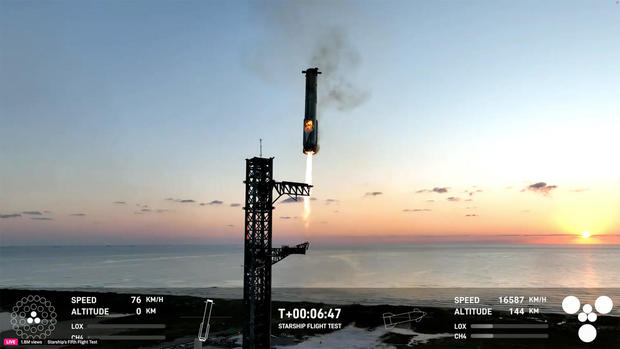
But the most astonishing achievement was the successful catch of the 23-story Super Heavy booster rocket by the launch tower’s mechanical arms, popularly known as “chopsticks.” This spectacular maneuver marked the highlight of the rocket’s fifth test flight.
The use of mechanical arms to catch the descending Super Heavy booster represents an unprecedented milestone in SpaceX's mission to develop fully reusable, rapidly relaunchable rockets, a technological feat unparalleled in the history of space exploration, which previously relied on expendable rockets.
SpaceX founder Elon Musk declared on his social media platform X, “Today we took a major step toward making life multi-planetary.”
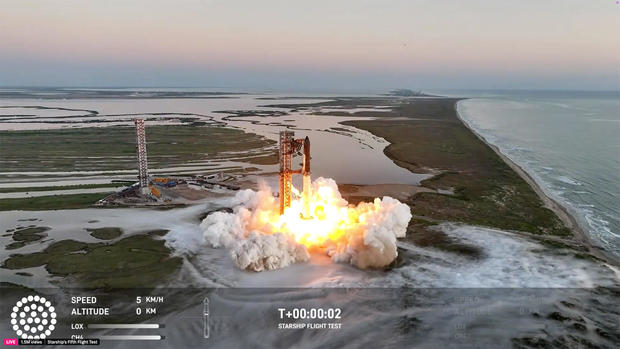
At 8:25 a.m. ET, the 397-foot-tall rocket lifted off from SpaceX’s launch site in Boca Chica, Texas, near the Gulf of Mexico. The booster’s 33 methane-fueled Raptor engines ignited with a thunderous roar, lighting up the dawn sky with a spectacular display of fire and exhaust.
Three minutes and 40 seconds after liftoff, the Super Heavy booster separated, flipped, and reignited 13 of its Raptor engines to guide its return to the Texas coast. Meanwhile, the Starship upper stage, powered by six Raptor engines, continued its ascent into space.
The booster’s flight computer was programmed to redirect the rocket into the Gulf of Mexico if any issues occurred with the rocket or the launch pad’s capture mechanism. However, no issues were detected, and flight controllers gave the green light for the Super Heavy to proceed toward the launch pad. It descended at an angle, straightened up upon approach, and was gently caught by the two mechanical arms as its engines shut down.
This breathtaking catch is a crucial component of Musk’s goal of achieving rapid reusability. As the Starship upper stage was still traveling toward space and splashing down in the Indian Ocean to simulate a future landing on the Moon or Mars, SpaceX made significant progress in advancing the design.
Musk has long emphasized that his primary reason for founding SpaceX in 2002 was to help humanity colonize Mars. In 2016, at the International Astronautical Congress (IAC), Musk first introduced the concept of the BFR (Big Falcon Rocket) and unveiled his "Interplanetary Citizen" plan.
Over time, the BFR concept evolved into the current Starship project. The Starship consists of two stages: the Starship vehicle, which is powered by six Raptor engines, and the Super Heavy booster, which is equipped with 33 Raptor engines. According to SpaceX’s design, the Starship stands approximately 120 meters tall with a 9-meter diameter, with the Starship vehicle itself measuring 50 meters in height and the Super Heavy booster at 70 meters.
Starship is key to Musk’s vision of reaching Mars. In September, Musk revealed that the first Starship destined for Mars would launch within two years, when the next Earth-Mars transfer window opens.
Musk emphasized that this flight would be an uncrewed mission, focusing primarily on testing the feasibility of landing on Mars. If the landing goes smoothly, SpaceX’s first crewed mission to Mars is planned for four years later. "From that point, the flight frequency will increase exponentially, with the goal of building a self-sustaining city on Mars within about 20 years."
Follow us
Find us on Twitter, Instagram, YouTube, and TikTok for frequent updates on all things investing.
Have a financial topic you would like to discuss? Head over to the uSMART Community to share your thoughts and insights about the market! Click the picture below to download and explore uSMART app!
Important Notice and Disclaimer:
We have based this article on our internal research and information available to the public from sources we believe to be reliable. While we have taken all reasonable care in preparing this article, we do not represent the information contained in this article is accurate or complete and we accept no responsibility for errors of fact or for any opinion expressed in this article. Opinions, projections and estimates reflect our assessments as of the article date and are subject to change. We have no obligation to notify you or anyone of any such change. You must make your own independent judgment with respect to any matter contained in this article. Neither we or our respective directors, officers or employees will be responsible for any losses or damages which any person may suffer or incur as a result of relying upon anything stated or omitted from this article.
This document should not be construed in any jurisdiction as constituting an offer, solicitation, recommendation, inducement, endorsement, opinion, or guarantee to purchase, sell, or trade any securities, financial products, or instruments or to engage in any investment or any transaction of any kind, nor is there any intention to solicit or invite the purchase or sale of any securities.
The value of these securities and the income from them may fall or rise. Your investment is subject to investment risk, including loss of income and capital invested. Past performance figures as well as any projection or forecast used in this article is not indicative of its future performance.
This advertisement has not been reviewed by the Monetary Authority of Singapore