

 Singapore
 Hongkong
 United States
 Group
Group Log In
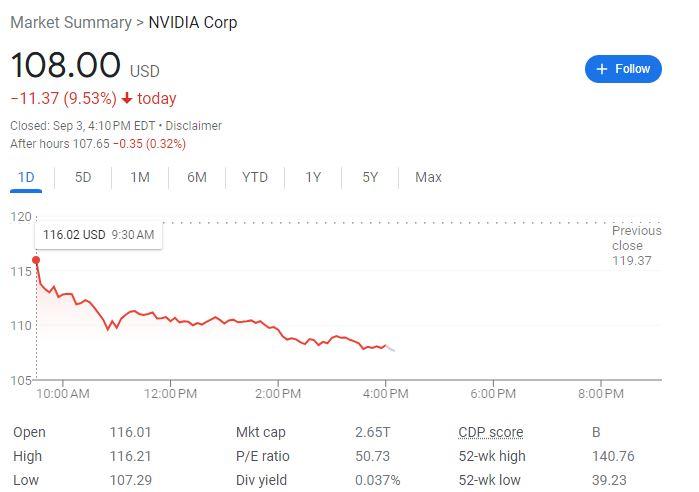
On September 3rd (Tuesday), the U.S. stock market experienced a harsh reality on the first trading day of September following a long weekend. The term “harsh” aptly describes the market conditions, and “plunge” accurately characterizes the drop in Nvidia and other semiconductor stocks. Nvidia's stock opened significantly lower with a 2.8% gap, then continued to decline, eventually closing down 9.5% at $108, marking a three-week low since August 9. The beloved Wall Street stock, Nvidia, saw its market value evaporate by $279 billion, setting a record for the largest single-day market value drop in history.
Source: The Wall Street Journal
Semiconductor Industry Hits Hard
The dramatic drop in Nvidia's U.S. stock price had a ripple effect on global semiconductor and related stocks on Wednesday. In the U.S., chip manufacturer Nvidia plummeted over 9% during regular trading, and semiconductor stocks followed suit amid a Wall Street sell-off. Economic data released on Tuesday further fueled concerns about the health of the U.S. economy. In after-hours trading on Tuesday, Nvidia’s stock continued to decline, falling 1.5% after Bloomberg reported that the company had received a subpoena from the U.S. Department of Justice as part of an antitrust investigation. Nvidia’s market value dropped approximately $279 billion on Tuesday, setting the record for the largest single-day market value loss in U.S. stock history. The previous record was held by Meta, Facebook’s parent company, which saw its market value drop $232 billion in a single day in February 2022.
Nvidia’s value chain extends to South Korea, including memory chip manufacturers SK Hynix and conglomerate Samsung Electronics. Samsung’s stock closed down 3.45%, while SK Hynix, which provides Nvidia with high-bandwidth memory chips, fell 8%. Tokyo Electron, a semiconductor testing equipment supplier, dropped nearly 8.5%. Japanese conglomerate SoftBank Group, which holds shares in chip design company Arm, fell 7.7%. Contract chip manufacturer Taiwan Semiconductor Manufacturing Company (TSMC) saw its shares decline by over 5%. TSMC produces Nvidia’s high-performance graphics processing units used to support large language models—machine learning programs capable of recognizing and generating text. Foxconn, known formally as Hon Hai Precision Industry, saw a nearly 3% drop. The company has a strategic partnership with Nvidia. The Asian sell-off impacted European semiconductor stocks as well. ASML, which manufactures key equipment for advanced chip production, fell 5% in early trading. Other European companies, including ASMI, BE Semiconductor, and Infineon, also experienced declines.
Reasons Behind the Plunge?
The enthusiasm for AI is cooling. First, Reuters points out that investors have recently seemed to "diminish their optimism towards AI-related stocks." Artificial intelligence technology has disrupted the tech industry over the past two years, with a surge of funds and investments pouring into companies in this field due to the rise of AI, leading to stock price increases for companies benefiting from this boom, such as Nvidia. While AI does not appear to be a bubble, investors now seem concerned that it is being overhyped—or at least worried that high returns might take longer to materialize than many hoped. Given the news announced by Nvidia in its earnings call last week, these concerns seem justified: revenue surged 122%, but investors were clearly dissatisfied with the future guidance, even though the company raised its forecast. In other words, Nvidia indicated that the company will continue to grow—but at a pace that will not meet investors' expectations.
Signs of industry weakness. UBS analyst Timothy Arcuri reported that chip sales fell 11.1% in June-July, below the 5-year and 10-year averages. Arcuri noted, "Memory is a major downside factor, with declines in key segments including MCU (microcontrollers), DSP (digital signal processors), and analog chips being worse than the seasonal trends of the past 5 and 10 years." Morgan Stanley's analysis indicated that the report was "weaker than our expectations across almost all product lines" and noted, "The overall market still looks weak, although we still believe that sales in areas such as analog chips, discrete devices, and MCU chips have bottomed out in Q2, with limited subsequent recovery."
The U.S. Department of Justice is investigating Nvidia for antitrust issues. In recent weeks, the DOJ has been inquiring with tech companies about Nvidia's business practices, including issues related to the company's hardware bundling practices. Besides bundling, the DOJ is also investigating Nvidia's investment acquisition deals, including a $700 million deal for the acquisition of Israeli company Run:in April this year.
How to trade investments on uSMART:
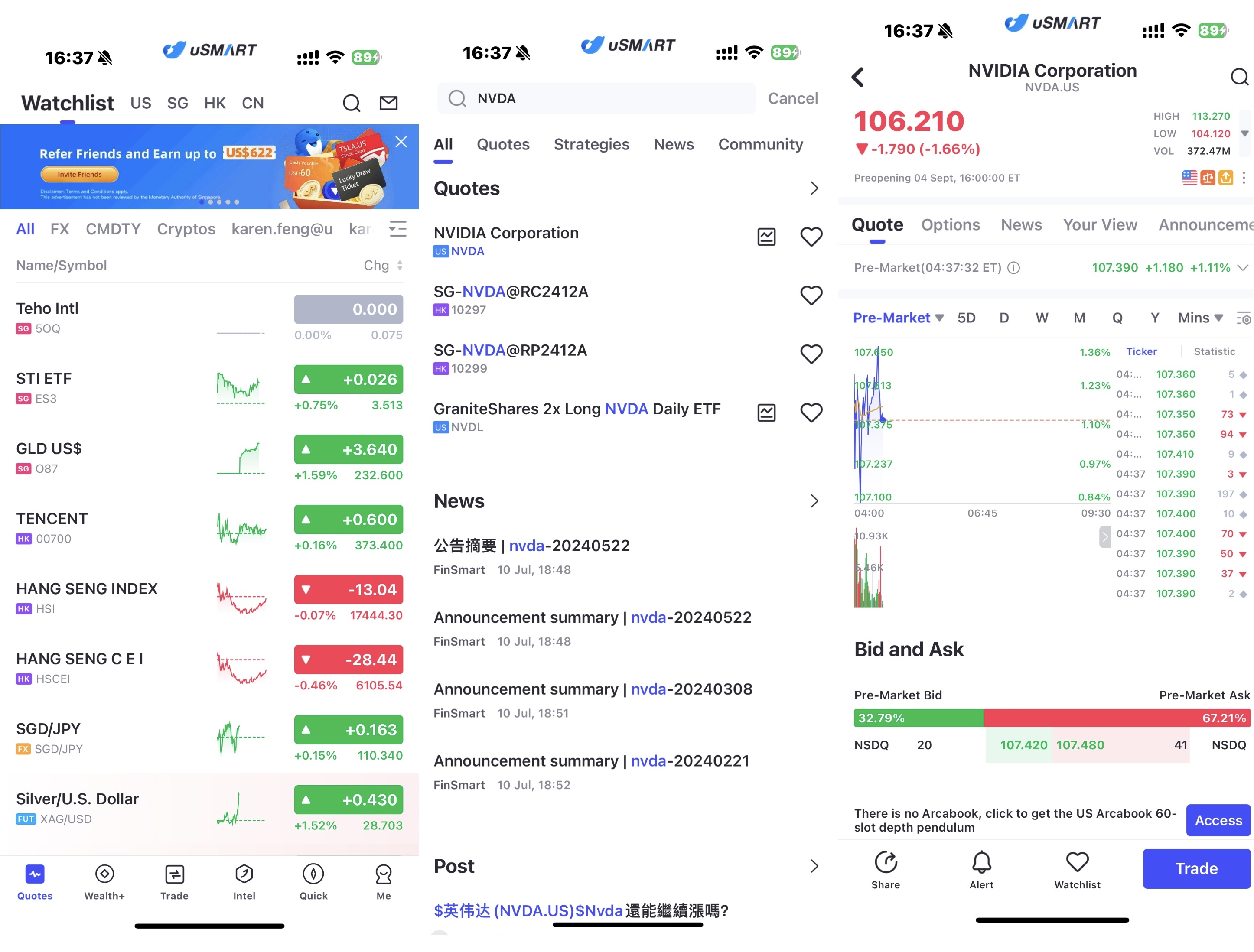
After logging into uSMART SG APP, click "Search" from the upper right corner of the page, enter the target code, such as "SMCI", and enter the details page to learn about transaction details and historical trends. Click "Trade" in the lower right corner and select "Buy/Sell" "Send" function, finally fill in the transaction conditions and send the order; the image operation instructions are as follows:
Source: uSMART SG
Follow us
Find us on Twitter, Instagram, YouTube, and TikTok for frequent updates on all things investing.
Have a financial topic you would like to discuss? Head over to the uSMART Community to share your thoughts and insights about the market! Click the picture below to download and explore uSMART app!
Important Notice and Disclaimer:
We have based this article on our internal research and information available to the public from sources we believe to be reliable. While we have taken all reasonable care in preparing this article, we do not represent the information contained in this article is accurate or complete and we accept no responsibility for errors of fact or for any opinion expressed in this article. Opinions, projections and estimates reflect our assessments as of the article date and are subject to change. We have no obligation to notify you or anyone of any such change. You must make your own independent judgment with respect to any matter contained in this article. Neither we or our respective directors, officers or employees will be responsible for any losses or damages which any person may suffer or incur as a result of relying upon anything stated or omitted from this article.
This document should not be construed in any jurisdiction as constituting an offer, solicitation, recommendation, inducement, endorsement, opinion, or guarantee to purchase, sell, or trade any securities, financial products, or instruments or to engage in any investment or any transaction of any kind, nor is there any intention to solicit or invite the purchase or sale of any securities.
The value of these securities and the income from them may fall or rise. Your investment is subject to investment risk, including loss of income and capital invested. Past performance figures as well as any projection or forecast used in this article is not indicative of its future performance.
This advertisement has not been reviewed by the Monetary Authority of Singapore